





Integrated noise and airflow-path design: A blower box that reduces medical device development effort
-
Health & wellness
-
CPAP
-
Ventilator
-
Portable oxygen concentrator
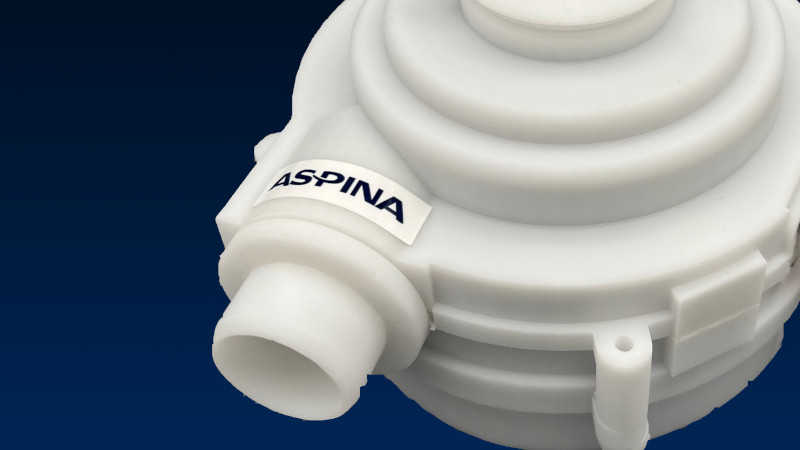
For respiratory medical devices such as Continuous Positive Airway Pressure (CPAP) devices used to treat sleep apnea syndrome and ventilators, blower noise is an unavoidable design challenge. Traditionally, blower boxes using sound-absorbing materials have been widely used for noise reduction. However, from a safety perspective, there is growing demand for noise-reduction technologies that do not use sound-absorbing materials.
To address this need, ASPINA has developed a blower box that reduces noise without using sound-absorbing materials by combining fluid-control design and acoustic design technologies. By providing an integrated module that combines noise reduction and airflow-path design, ASPINA helps respiratory device manufacturers reduce the design and evaluation effort required for medical device development. The module can also be equipped with sensing functions required for device control, contributing to enhanced functionality.
Noise-reduction challenges facing medical device manufacturers
A blower is an essential component in respiratory medical devices because it supplies airflow. At the same time, it is also a source of noise. Manufacturers of respiratory care devices must achieve sufficient noise performance in the final product, which requires implementing noise reduction measures in the device that incorporates the blower. For example, CPAP devices typically target a noise level of approximately 25 to 30 dBA. A common approach is to enclose the blower within a blower box. However, developing such a solution requires specialized knowledge and evaluation equipment, increasing development effort and time.
Furthermore, conventional blower boxes often use polyurethane-based sound-absorbing materials to reduce noise. Although these materials can provide effective noise reduction, they may raise concerns regarding patient safety in medical device applications. If particles or chemical substances generated by material degradation enter the airflow path, they may pose a potential safety concern. As a result, there is growing interest within the medical device industry in noise-reduction technologies that do not rely on sound-absorbing materials.
ASPINA received feedback from customers who had developed blower boxes in-house but were facing many of these challenges and could not find an effective solution. In response, ASPINA's Medical Engineering Business Unit began developing a dedicated blower box solution.
Focusing on flow-induced noise
Noise generated around a blower can originate from several sources:
- Flow-induced noise generated by airflow
- Vibration noise caused by the motor and rotating components
- Noise resulting from resonance of the blower box or the medical device enclosure
During the early stages of blower box development, it was necessary to determine which noise source should be prioritized.
Through evaluation testing, ASPINA found that the internal structure of the box significantly affected sound characteristics. Moreover, during workshops with customers on products under development, ASPINA frequently heard comments that the sound of airflow was noticeable and potentially bothersome.
After evaluating the effectiveness of various countermeasures and considering development time, ASPINA decided to focus first on reducing flow-induced noise. ASPINA used Computational Fluid Dynamics (CFD) analysis to investigate internal structures capable of reducing noise energy associated with flow-induced noise. Based on the simulation results, prototypes were manufactured and evaluated through actual noise measurements. By utilizing 3D printing, prototypes could be produced quickly, enabling repeated cycles of testing and design improvement. During the development process, ASPINA also found that noise levels could be reduced not only by suppressing noise energy but also by utilizing acoustic interference effects.
By combining Computational Fluid Dynamics (CFD) analysis and acoustic analysis throughout the design process, ASPINA successfully achieved a high level of noise reduction performance. As a result, ASPINA developed a blower box that achieves the same level of noise reduction as conventional sound-absorbing designs, without relying on sound-absorbing materials.
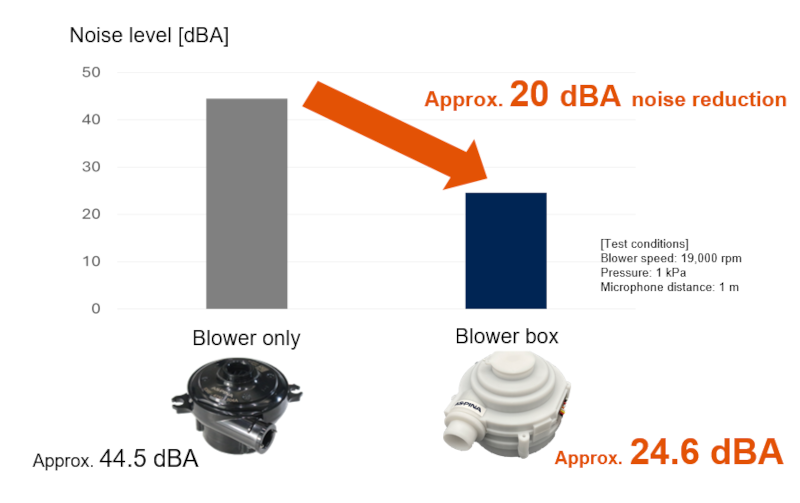 Measured noise level of the newly developed blower box compared with the blower alone under ASPINA's test conditions
ASPINA’s solution from development to mass production
The role of a blower box extends beyond noise reduction. By incorporating airflow-path design, it can also help reduce the design effort required by medical device manufacturers.
In respiratory medical devices, airflow-path design around the blower is also an important development consideration. Engineers must ensure sufficient airflow and pressure while simultaneously minimizing pressure loss, managing heat and reducing noise. Because these requirements influence one another, this area often demands significant design and evaluation effort for respiratory device manufacturers. ASPINA's blower box is designed not only as a housing for the blower but also as an integral part of the airflow path. During development, Computational Fluid Dynamics (CFD) analysis was used to optimize the internal airflow path while considering its impact on airflow and pressure performance. As a result, customers can reduce the effort required to design airflow paths around the blower from scratch and also cut down on the engineering effort associated with noise-performance evaluation.
ASPINA has also addressed challenges that are unique to enclosed blower systems.
For example, covering a blower to reduce noise can lead to heat accumulation inside the enclosure. Thermal management becomes particularly important when using high-output blowers for ventilator applications. Depending on application requirements, cooling paths can be incorporated to balance noise reduction and cooling performance.
In addition to product design, ASPINA takes manufacturing and quality assurance into consideration throughout the development process. From the early stages of development, production engineering, quality assurance, and procurement teams are involved to support a design approach that considers manufacturability, product quality, and mass-production readiness. Stable mass production is also considered during development.
Materials can be selected based on application requirements, including considerations for flame retardancy and biocompatibility.
As a result, ASPINA's blower box provides the following benefits and supports customers’ product development:
- Eliminates safety risks associated with sound-absorbing materials
- Reduces engineering effort for system-level noise control by taking aerodynamic noise, mechanical vibration and structural resonance into account in the enclosure design
- Reduces engineering effort for airflow-path design, including pressure-loss reduction and thermal management considerations
- Provides quality assurance not only for the blower itself but also for surrounding components
Custom sizing, module integration and contract manufacturing support
ASPINA's blower box can be customized to meet customers' specific applications and requirements. ASPINA can also offer support tailored to customer needs, from control board manufacturing to complete assembly solutions. ASPINA possesses expertise not only in motor technology but also in drive and control systems, sensing technologies and PCB development. By combining these capabilities, ASPINA can provide integrated modules that include the blower, enclosure and control circuitry. Rather than simply supplying individual components, ASPINA supports the customer's overall product development process. This ability to provide comprehensive support is a major strength that distinguishes ASPINA from other companies.
For detailed specifications, product information or technical inquiries, please contact us using the button below.
Exhibition information
-
Oct. 13, 2026
-
Oct. 13, 2026
-
Jul. 24, 2026
Related information
-
NEMA17 stepper motor selection guide: Mounting dimensions, applications, selection and problem solving
-
IEC 60601-1 explained: Key motor selection considerations for medical devices
-
ASPINA’s new servo motors enhance competitiveness in medical device development
-
NEMA stepper motor sizes chart and selection guide